A pre-mortem is a meeting where you imagine your project has already failed and work out why. Gary Klein described the method in Harvard Business Review in 2007: team members assume that the project they’re planning has just failed. Starting from “we failed” turns vague worries into specific stories you can check.
For a startup, the best time to run one is before you commit money to a build, while every risk is still cheap to test. This guide gives you a 90-minute format, a template with a filled-in example, and the step most pre-mortems skip: turning each failure story into a test, a stop rule or a smaller first release.
When to run a pre-mortem
before you sign a budget for a first version or a big new release
before a fundraise, so you can answer “what are your risks?” with specifics
before you hire a development team or switch to a new one
after a pivot, when the old assumptions no longer hold
The 90-minute session
Minutes
Step
What you end up with
0-10
Set the scene: “It’s 12 months from now. The product failed.”
Everyone working from the same failure date
10-30
Everyone writes failure stories alone, each starting with “We failed because…”
3 to 5 stories per person
30-50
Read them out, merge duplicates, vote on the most likely
5 to 7 failure stories
50-75
Find the root cause of each top story
One root cause per story
75-90
Pick a defense and an owner for each cause
A list of tests, stop rules and cuts, each with a name and a date
A 90-minute pre-mortem agenda
Invite the people who will build, sell and pay for the product. If you work with an outside development team, invite their lead too. They may have seen products like yours fail in ways you haven’t.
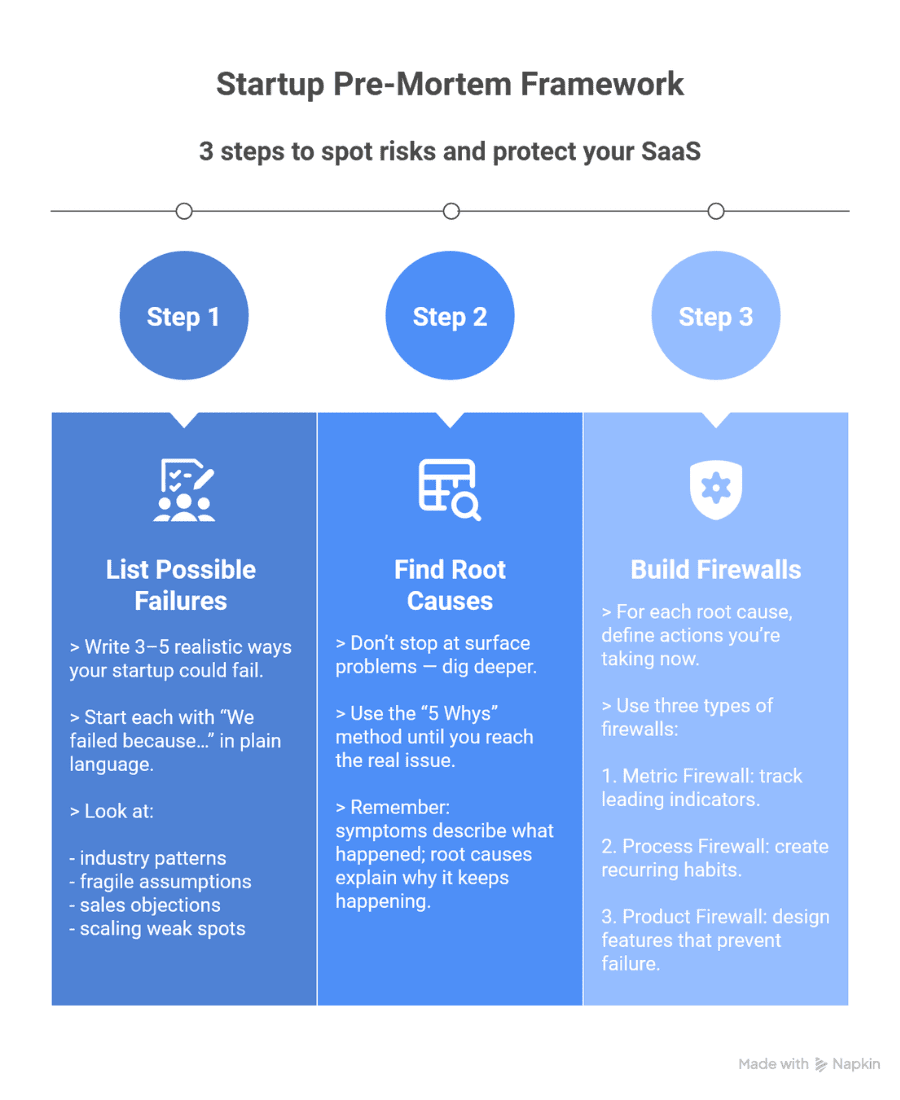
Step 1. Write failure stories, not risk categories
“Technical risk” is a category. “We failed because the AI scoring was wrong one time in five and customers stopped trusting it” is a story you can test. Push the room for stories.
Real shutdowns give you a starting list. CB Insights looked at 431 venture-backed startups that shut down since 2023 and found the reasons for 385 of them. Running out of capital came up in 70% of cases, poor product-market fit in 43%, bad timing or the economy in 29% and unit economics that didn’t work in 19%. The report calls running out of capital almost always the final cause of death, not the root problem. Step 2 below is for finding that root problem.
For a product build, look for stories in five areas:
Product: users didn’t need the main feature, or didn’t pay for it.
Build: the first release was too big and took twice as long as planned.
Platform: the app store rejected the app, or an outside API didn’t do what we assumed.
Team: the person who knew the code left, or nobody on our side had time to make decisions.
Money: we spent the budget before we learned whether anyone would pay.
Platform stories are common for apps. In 2025 Apple reviewed 9,100,620 App Store submissions and rejected 2,093,244 of them. Performance problems were the most common reason, with 1,354,418 rejections (App Store Transparency Report 2025). Google Play has its own deadlines: from 31 August 2026, new apps and app updates must target Android 16 to be submitted (Google Play target API level requirements).
Step 2. Find the root cause
For each top story, keep asking “why did that happen?” until you reach something you can change. Five rounds is the usual rule of thumb.
Story: we ran out of money before launch.
Why? The build took five months instead of two.
Why? The first release grew from one job to six.
Why? Every investor meeting added a feature.
Why? Nobody owned the rule for what goes into the first release.
Root cause: there was no written scope, and no one person who could say no.
The late launch is the symptom. The cause is a missing decision rule, and writing one takes an afternoon.
Step 3. Turn each cause into a defense
For each root cause, pick at least one defense you can start this month:
A metric that warns you early: “If the first release has more than 15 user stories, we review the scope before building.”
A habit that deals with the cause: “Every feature request from an investor goes on a later list, and the product owner reviews that list once a month.”
A product decision that removes the risk: “Sign-up and payments come from ready-made modules, so the build time goes into the one main feature.”
Then add two things most pre-mortems leave out.
The first is a test before the build. If a story depends on something technical you haven’t proven, test that first. On Subflare, an AI lead scoring product, we tested the risky AI part in 2 weeks before building the MVP. Our discovery sprint also sets aside one day for the riskiest technical question, for example running an AI model on 10 to 20 of your real examples.
The second is a stop rule. Decide now what result makes you stop, change course or cut scope. “If fewer than 10 of our first 50 pilot users come back in week two, we stop adding features and go talk to them” is a stop rule. Write it down with a date, because the call gets harder once the money is spent.
A filled-in example
Failure story
Root cause
Defense
Owner and date
The App Store rejected the app two weeks before launch
Review was planned as the last step, with no buffer
Send a build to review early, and check the app against the store rules for its category
Product owner, before the second sprint
Professionals didn’t move their bookings into the app
Nobody asked how they take bookings today
Interview 10 professionals about their last 10 bookings before building the calendar
Founder, within two weeks
The calendar took twice as long as planned
The full custom calendar was in the first release
Ship a first version of the calendar, and move notifications forward
Tech lead, at scoping
The budget ran out in month four
No checkpoint between “start” and “launch”
A spending checkpoint at 50% of the budget, with a continue, cut or stop decision
Founder, written into the plan
Pre-mortem template, filled in for an example booking app for independent professionals
The defenses in the first and third rows come from a real project. On Traza, a booking app for tattoo artists, the launch date was already promised and App Store review can take one to two weeks. So we sent the app to review early instead of polishing it until the last day, and it was approved on both stores. When the custom calendar grew bigger than planned, we cut it to a first version and moved push notifications and booking creation forward.
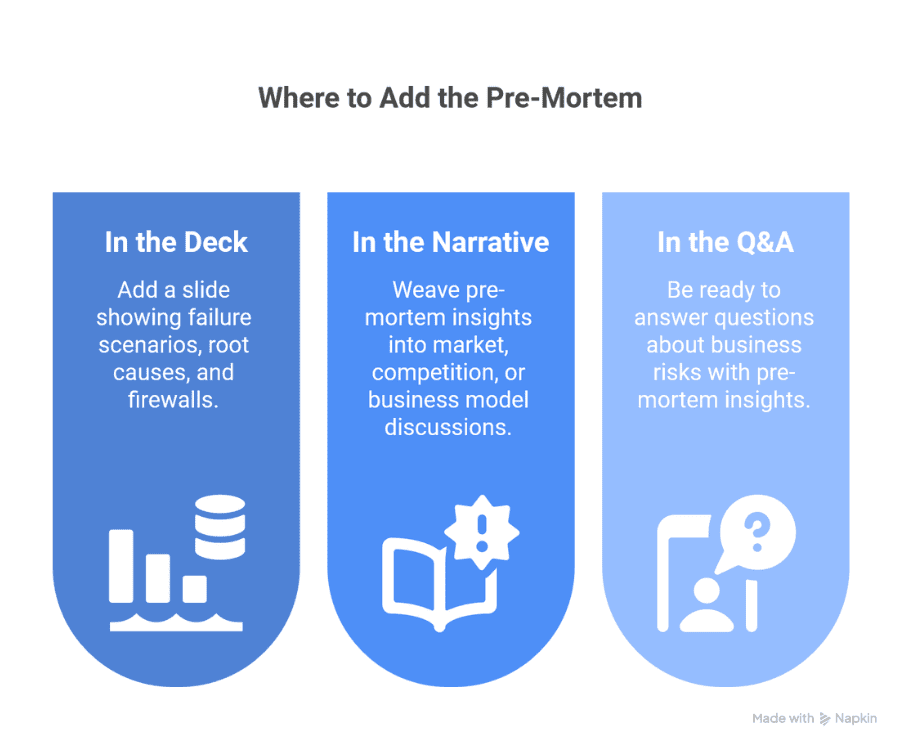
Using the pre-mortem with investors
Investors ask about risks to find out whether you’ve thought about them. A pre-mortem gives you a specific answer: the two or three most likely failure stories, their causes and what you’re already doing about each. Put them on one “Risks and defenses” slide, use them when you talk about the market and competitors, and keep the full table ready for questions.
Scope: the estimate turns your brief into user stories. You confirm what is in scope, and every hour in the budget traces back to a story you kept.
Market: the discovery option suggests customer groups and gives each a TAM, SAM and SOM, with a note on what the number covers. The estimate itself calls these hypotheses to test, not verified demand.
Money: it shows how many customers pay for the build and in which month the build is paid back, from five starting numbers you can change.
Turn each one into a failure story. “We failed because the customer group was much smaller than we assumed.” “We failed because winning a customer cost twice our guess, and payback moved past our runway.” Change the starting numbers to your pessimistic case and watch the payback month move. If it lands after the money runs out, you have a stop rule with a number in it.
What we would do
Book 90 minutes before you commit the build budget, with the people who will build, sell and pay.
Have everyone write failure stories alone first, then merge and vote.
Find one root cause for each top story.
Give each cause a defense, an owner and a date.
Test the riskiest technical assumption before the main build.
Write stop rules with dates, and cut the first release down to what tests your main assumption.
Run the pre-mortem again before the next big release.
Do you need expert advice on writing a pre-mortem for your startup? We are here to help. Get a free consultation.
FAQ
What is a pre-mortem analysis?
A meeting where the team imagines the project has already failed and works backward to the reasons. Gary Klein described the method in Harvard Business Review in 2007.
When should a startup run a pre-mortem?
Before committing a budget to a first version or a big release, before a fundraise, before hiring or switching a development team, and after a pivot.
How long does a pre-mortem take?
About 90 minutes: 10 to set the scene, 20 to write failure stories alone, 20 to merge and vote, 25 to find root causes and 15 to assign defenses and owners.
What is the difference between a pre-mortem and a risk assessment?
A risk assessment lists what might go wrong. A pre-mortem starts from a failure that has already happened and asks why, which gives you specific stories you can test.
How do you use a pre-mortem in a pitch deck?
Add one “Risks and defenses” slide with the two or three most likely failure stories, their root causes and what you’re already doing about each.
Turn your assumptions into a project brief
Turn a pre-mortem into owned tests, stop conditions and a smaller release rather than a list of fears. Review startup development and the Guestroom case when deciding how to translate those risk controls into delivery work. Explore software development for startups and the Guestroom case study.