How to Scale a Marketplace: Liquidity Before Growth
Decide when to expand a marketplace using liquidity, repeat transactions, operating capacity and bounded acquisition tests—not traffic alone.
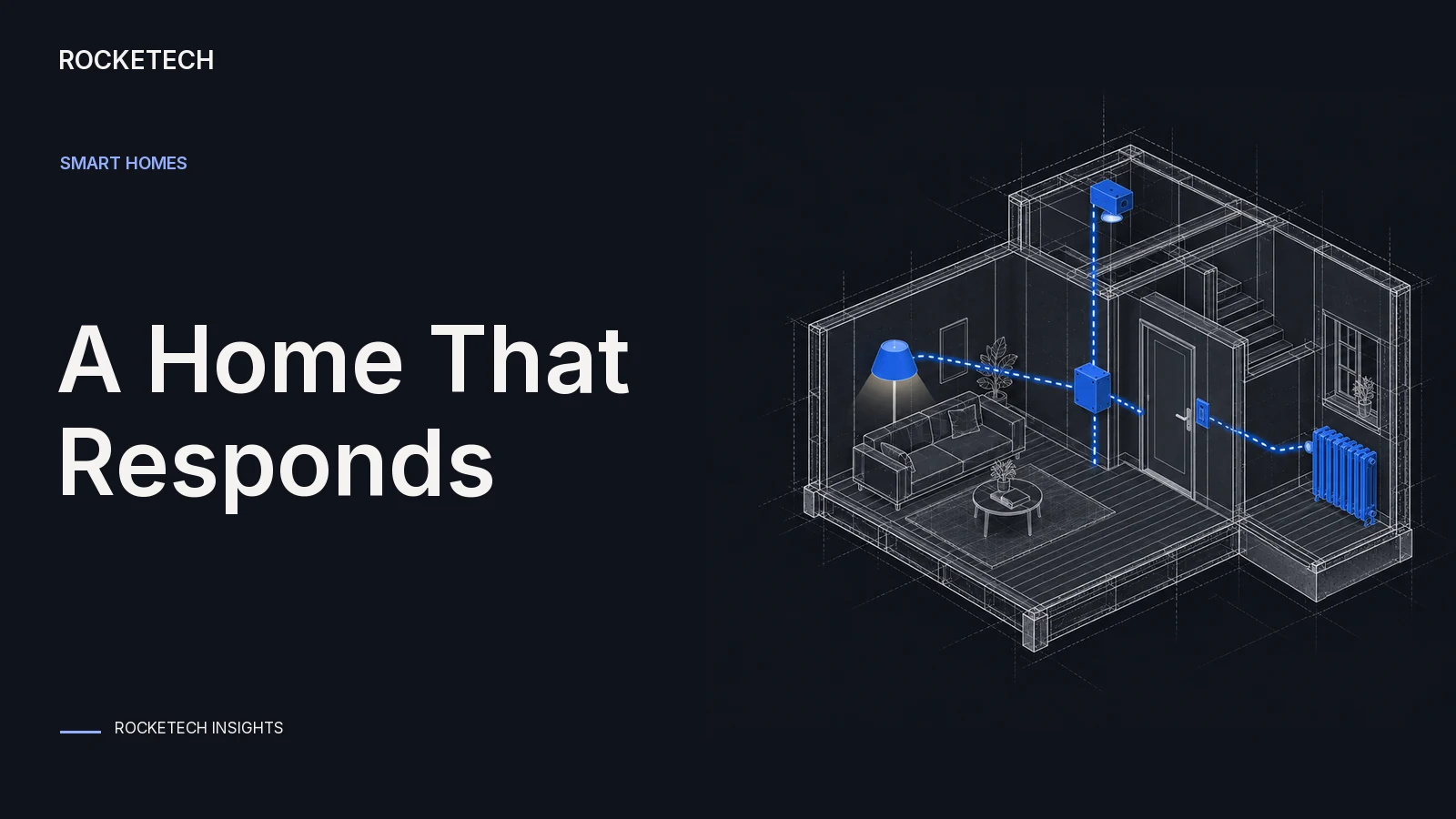
If you are making a smart home device in 2026, decide first whether it speaks Matter, the shared standard that lets one device work in Apple Home, Google Home and other platforms. Features come after. That choice sets what you build, what you pay to certify and what your own app still has to do. This guide walks through the three routes, with facts taken only from the Connectivity Standards Alliance (CSA), which runs Matter, and from Apple’s and Google’s own pages.
Matter now covers more of the home than it did in 2022. Matter 1.5, released on 20 November 2025, added cameras that stream live video and audio over WebRTC, closures such as shades, gates and garage doors, an electrical energy tariff device type, and full TCP support for larger transfers such as faster firmware updates (CSA, Matter 1.5). Matter 1.5.1, on 31 March 2026, added several video and audio streams per camera session and fixes for doorbells, chimes and intercoms (CSA, Matter 1.5.1).
Matter moves pairing out of your app and into the phone’s system, and it lets more than one app control your device.
| Route | What owners get | What you build | Fits when |
|---|---|---|---|
| Matter only | The device works in Apple Home, Google Home and other Matter apps, with no app of yours | Firmware on Matter, then certification | Simple devices: plugs, bulbs, sensors, switches |
| Your own app and server only | Your app, your features, your accounts | App, server and device link; you support every phone yourself | Features Matter doesn’t define, or a closed system such as devices in rented flats |
| Matter plus your own app | Everyday control in the home platforms, extra settings and paid services in your app | Both of the above | Cameras, energy devices, anything with a subscription or cloud history |
Our view: for most consumer devices the third route is the sensible default in 2026. Matter handles everyday control in the apps people already use. Your app does the parts that make your product different and the parts you charge for.
To certify a product and use the Matter logo, a company joins the CSA. The CSA’s membership page lists these fees (CSA, become a member):
| Level | Yearly fee | Product fees and rights |
|---|---|---|
| Adopter | $7,500 | $3,000 per product to develop, test and certify; can use Alliance logos on certified products |
| Associate | $0 | $2,500 per product plus $500 per product each year; logos only on white-labelled products through the Certification Transfer Program |
Two higher levels, Participant and Promoter, cost $21,500 and $112,500 a year. Adopter is the lowest level that can certify products and use the logos. Add your own engineering and testing time on top.
Even on the third route, your companion app carries real work. It explains setup and what to do when pairing fails, including the Thread border router question. It holds the settings that Matter doesn’t define for your device type. It runs accounts, subscriptions and any cloud history, such as stored camera clips. And it gives support a way to see what went wrong.
Keep that app small. Owners will control the device from Apple Home or Google Home most days, so your app earns its place on the phone through setup, support and the features you sell.
Certification under Matter doesn’t replace product security law. In the UK, since 29 April 2024, consumer connectable products need passwords that are unique per product or set by the user, a published way to report security issues, and published information on the minimum security update period (UK government, PSTI). In the EU, the Cyber Resilience Act’s reporting obligations apply from 11 September 2026 and its main obligations from 11 December 2027 (European Commission, CRA). This is planning information, not legal advice.
None of our published case studies is a Matter device. What we have done is the app side of a connected product. On PIX, the client’s team owned an LED backpack, and we built a React Native app that talks to it over Bluetooth LE and sends it images and video. On a Matter product we would expect the same split: your hardware team or a firmware partner owns the firmware and certification, and we build the companion app, the server and the admin side.
Our guide to how mobile apps work with IoT devices covers that kind of build in detail: the connection choice, iOS and Android pairing rules, and cost.
An estimate for a smart home product should separate three budgets: the device and its firmware, certification, and the app with its server. Ours covers the third.
You can see what your idea costs to build from a short brief. The estimate turns the brief into user stories, such as “pair a new device in Apple Home and our app” or “watch yesterday’s camera clips”. You confirm what is in scope, and every hour in the budget traces back to a story you kept. We check the hours the model suggests against what our team actually books on finished projects, then multiply by our published rate of $39-55 an hour. It is a planning range, not a fixed quote. Our published price for a first version of a mobile app is $5,000-15,000, typically 2-4 weeks plus store review.
Matter is a smart home standard run by the Connectivity Standards Alliance. A Matter device can be set up and controlled from several platforms, such as Apple Home and Google Home. It runs on Wi-Fi and Thread, and uses Bluetooth Low Energy to set up new devices.
Not for basic control, which works in the home platforms’ apps. You still need one for anything Matter doesn’t define for your device, for accounts and subscriptions, for cloud history such as camera clips, and for setup help and support.
The CSA lists Adopter membership at $7,500 a year plus $3,000 per product to develop, test and certify. Associate membership has no yearly fee, but costs $2,500 per product plus $500 per product each year and covers only white-labelled products.
Yes. Matter 1.5, released on 20 November 2025, added cameras that stream live video and audio over WebRTC, and Matter 1.5.1 in March 2026 added several streams per camera session.
Carefully curated content for resourceful Devs, CTOs, and PMs. No spam.